Search This Blog

Thursday, January 3, 2019

Geocaching in and around Newport, Tennessee


On New Years Day, 2019, our annual holiday adventure took us through Tennessee (by car, not bike,
given the unpredictability of winter weather). We stopped in the little town of Newport, Tennessee, drawn there by a geocache, of course. The one Jeff had selected was a war memorial, on the grounds of the courthouse, directly across the street from an old stone building.

Notwithstanding Wikipedia's account of this town as a historical hotbed for moonshine, prostitution, and other hi-jinx, the small town was sleepy on this holiday morning, except for the train that rumbled through on the tracks bisecting a main thoroughfare. On the porch of the old stone building, a man and woman sat watching the world go by.
The gentleman called out to me as I was snapping pictures. They had seen us rolling past a few moments before, and of course, noted the out-of-state license plate. The gentleman was eager to chat, inquiring where we were from and quick to point out that his porch was part of a historical building, an old hotel, as confirmed by the sign hanging outside. He said the building was currently being use as a home for the old and disabled.  It had also previously been a hospital, with the next-door building, also built of stone, serving as the doctors' offices.

Except for the notable stone buildings (three in all), the courthouse area was typical of a small town other than the arrangement of eight park benches facing the courthouse steps like church pews. The benches' rainbow hues suggested the were poised to host the guests for a same-sex wedding, to be celebrated on the steps of City Hall, but somehow, I don't think that was really the case. Their purpose remains a mystery.

After completing our stop at the war memorial, we continued on to another geocache just outside of town that I had spotted on the map and thought would be interesting. The geocache description (written in 2010, I believe) read:

For many years Paul Stinson operated a down-home venue for live mountain music in Del Rio. Following his death, his followers continue to operate his club. Then about two years ago, the owner of the building closed it. Within a few days, they located a new home here. The train depot had been used for many purposes over the years, after having been moved to this location. For a time it was Texaco distribution warehouse, and for a time it was a County garage.

Renovations to this building were conducted by Doloris Dalton and Jess Parton, using donated materials recycled from old buildings, an excellent example of green thinking in that old materials are given new life. The windows of the depot were falling out, and there had been several forced entries into the building. So Dolores painted quilt squares on plywood, and Jess replace the windows with quilt panels. On Saturday nights, many local musicians come here to play, and many local residents come to listen.

As we poked around the stone pillar supporting the porch, where we expected to find the cache, a pickup truck pulled in near the building and two people rushed down the hill toward us. Luckily for us, one of them introduced himself as Jesse.


He was excited to see people looking for the geocache. Although the record shows the cache been found recently, he had not seen anyone looking for a long time. Further, the cache was not on top of the stone pillar where we expected to find it. Determined, however, to locate it, Jesse pulled up the cover on the side of the porch and dove under, successfully fishing out the container from behind the stone pillar. As he did so, he provided an account of the history of the building, as above. Then, after we signed the log inside of the cache, and carefully replaced it on top of the pillar behind a loose brick, Jesse offered us a tour of the interior.

The building was wonderful. There was a stage at the far end and old church pews down the center for the audience to sit on. Where the old wooden floor was exposed it shone dark, likely stained with oil from its years as a Texaco warehouse. Along the walls there were booths where you could sit to eat, built by Delores and Jesse, and a small kitchen in the back. The heat pump had been salvaged from government surplus sold off after Katrina, where it had been used to heat tents. Delores saw on the internet that the heat pumps were being sold, and sent Jesse down to Louisiana to get one. They used old packing crate material to finish the walls, and old insulation from a church that was being renovated, to insulate the ceiling, which was otherwise just an open-beam cathedral-style ceiling. Most notably, the windows had been boarded over with plywood, painted in quilt-block patterns.
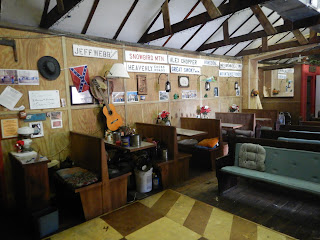
The walls and tables were decorated with all sorts of memorabilia, speaking of a close knit community of musicians and fans. Jesse took pains to point out a sketch on the back wall of a man he identified as “Hillbilly” (the Paul Stinson referenced above). Jesse said that Hillbilly and his friends would get together to play, which drew crowds of listeners. Jesse‘s mother was among those who used to play with Hillbilly (stand-up bass).The crowds exceeded the size of Hillbilly’s home, where they first gathered, and so he added an outdoor pavilion. After Hillbilly died, the new owner of the land discontinued the concerts for fear of lawsuits. Jesse pointed out to his mother that they could rent this old train depot and make that the new gathering spot. His mother was concerned that the venue wouldn’t be big enough, but Jesse suggested they go ahead and start with that and it’s been a success. He said that some nights there are only four or five patrons, and other times it’s standing room only.

Although we did not get to meet Jesse’s mother, we learned she is a cabinet builder (Spicewood cabinets?) and at 71 still runs her cabinet making business, takes care of her horses and her home, and runs this music venue. I would love to be here on a Saturday night!

Other Tennessee stops included a cantilevered block house and the grave of Davy Crockett's grandparents. Those were also geocaches, of course!


Additional pictures of the Music Barn: 


Sunday, October 21, 2018

October Weekend

Green, brown, and white are colors, but not the ones we hoped to see on our October leaf-peeping trip to Wellsboro, PA. We saw trees that had not yet turned, ones that had already lost all their leaves, and – horror – snow covered cars and grass!

Nevertheless, we had a lovely meandering trip north. Overnight in Gettysburg where the evening streets are crowded with character-dressed docents leading ghost tours, quick stops at World's End State Park (below) -- worth a return visit; in the one-street town of Forksville, founded 1790, with its covered bridge and sprinkling of Victorian houses; and odd little Wellsboro with its Winken, Blinken, and Nod fountain at the center of the town square.
We ate well too!  Appalachian Brewing Co. in Gettysburg advised us the wait would be 1 to 1.5 hours unless we were willing to be seated on the patio on a chilly Friday night.  But with a live band in the adjoining park, we were up for it.  Great food AND entertainment.  On Saturday evening, Timeless Destinations in Wellsboro provided excellent beer and pizza.  (Not quite as good as the pizza at C.J. Maggie's in Buckhannon WV, but that's a very, very high standard to meet). And Front Street Diner in Harrisburg, although not the height of cuisine, provided a nice stop and chance to observe a slice of local life on Sunday.


The return trip had a 20 degree temperature span, from 31 degrees at the start to a much more reasonable 51 degrees or so at the end. Brooding clouds yielded to bright skies and a blinding winter sun. We cut a lot of the planned Sunday itinerary to avoid potentially icy conditions.  So, except for a brief stop in Harrisburg, we headed home!


 Forksville PA - covered bridge and a full view of the "downtown"


A Wellsboro morning meander.


Weather!  Dramatic clouds, rain, snow, sun -- we got it all.

Monday, October 8, 2018

The Void 2018

The Void, held October 5-6, 2018, was my second rally. The learning continues.

I'm the pillion. In the first rally I did with Jeff, the MD 2020 in May 2018, my role was mostly just to hold the flag. I had seen the bonus list but didn't have the tools to do my own analysis, so I was limited to making comments based on intuition. I complained about being just a "sack of potatoes" on the back of the bike, and while Jeff assured me I was a "lovely sack of potatoes," he agreed that it would be more fun for both of us if I was more engaged.

Therefore, before the bonus list for the Void was released, Jeff introduced me to the spread sheet he uses for rally planning and analysis.  As soon as the list came out (very late) on the Friday night before the rally, I was able to populate my copy of the spread sheet and dump the data into Base Camp.  Then the two of us sat there for several hours independently poring over possible routes.

This rally had 3 possible starting locations for the "24 hour riders" (there was a 10 hour ride too), with everyone finishing in Fredericksburg VA. We were starting in Reading PA, which was the largest group. Despite the label "24 hour riders," the rally began on Friday at no earlier than 8:20 east coast time and no later than 9:30 a.m.; and concluded 31 hours after the start time (i.e., at 3:20 p.m. on Saturday, if you started at 8:20 a.m. on Friday, plus a minute to allow for time start confirmation.) Riders had to rest at least 3 hours and earned points for resting up to 3 additional hours.

Our approaches to planning were different.  Jeff developed and compared multiple candidate routes while I just added and subtracted from one.  When we compared notes, my candidate was the better backbone, as verified by comparison to his alternatives, so we focused on refining that one.  After more tinkering on Saturday morning, including trading possible bonuses for rest, the route was settled.  This rally didn't provide many options.  It wasn't as if there was if there were two or more possible routes, either of which might be a winner.  There was one possible winning route for Reading starters, and the only question was how many of the bonuses on that route each rider was capable of getting. Jeff is a polished rallier, but not aggressive rider, so riding a winning route well and getting into the top third of the finishers is a good result for us. Could we do it?

All the bonuses were worth either 13 points or 39 points. There were four bonuses on our initial candidate route that were 13 points each and consumed more time than average and, therefore, we designated them potential "drops" if necessary to get the route to close. There was a fifth 13-pointer that was such a stretch we didn't put into our proposed route at all, but which could have been a possible add-on if there was no traffic anywhere, anytime. (Luck is a part of rallying, and it doesn't always have to be bad!)  We dropped one of the four 13-pointers at the outset to assure we'd make the finish without a penalty. That gave us 33 planned bonuses (a mix of 39 point and 13 point ones), three of which were designated as potential drops.

Going into the 8th of our planned bonuses on the day of the ride, we had a pretty good margin over our predicted time and even began toying with the idea of the add-on, but then we got tangled in a traffic jam.  Ultimately we ended up pitching all of the other three contingency drops en route so that we'd finish with 30 bonuses (or "boni" in rally lingo).

Many of Jeff's past routines worked for us, but it's a continued learning process.  We picked a start location that was on the right side of a divided highway for our intended travel and checked it out the night before to assure our start receipt would have an accurate date and time.  The location was a 7-11 and when we asked what time was on the register we also explained why we wanted to know.  A woman, who I think was the owner, was seated near the door and asked a few questions about what we were doing. When we returned the next morning, she had already briefed the morning sales clerk about what we needed!  I brought a few things to the counter (Gatorade and snacks) at about 8:15, and the clerk scanned them in. Then we waited. At exactly 8:20 she hit the check-out button, gave me the receipt, and after texting it in, we were on our way!


For the rest bonus receipts, we also used a convenience store, next to our hotel.  For our rest-end receipt, I again arrived early and chatted up the clerk so she knew what I needed.  Despite the line, she had me at the register with items scanned at 6:28 a.m. (we needed a 6:29 a.m. receipt), and hit the button as soon as her register said 6:29.  Many thanks to all three of these wonderful women!

We were reasonably efficient at the bonuses.  I had the rally book and rules on my phone as well as my "cheat sheet" showing the order of the bonuses and notes about the picture, so I could double check Jeff, review all the details as needed en route, and answer any questions about the locations.  Jeff logged as we went, so there was no paper work issue at the end.  I knew his routine now, so if there was any variation I could question it, and that way we kept double-checking each other.  All that, together with Jeff's experience in taking good photos, helped us get a clean score at the end.  Nothing we thought we got was lost at the scoring table.

There was one area in which I think we got better at as the day went on - traffic anticipation. Since different GPS systems seem to react with different speeds and accuracy, it is helpful to look at multiple sources. Further, the GPS looks at the goals you've given it and the next location, and can't fully integrate options like "what if we reversed these?" or "what should we anticipate later today?" After we got caught unexpectedly in a jam caused by a truck with a wide load that had slid off the truck bed (!), I started doing more "looking ahead" on Waze and Google maps to see if there were things farther ahead on the route to anticipate.

The other learning (for me) was on placement of the rest stop.  We planned to do our first Saturday-only bonus at midnight and then continue on.  But with the earlier drops in the schedule, we arrived too early at our first Saturday-only bonus in Baltimore and so had dead-time while we waited for midnight.  Jeff had considered the hotel options in Baltimore, at least the part we were passing through, and concluded that there was nothing decent. (On rallies, the criteria for "decent" is pretty much "nothing that crawls, bites, or is contagious, and has safe parking for the bike" but with that last criteria included, it can still be hard to meet on some of our routes!)  However, had we stayed in Baltimore after the last of the Friday-only bonuses, we might have reduced that dead-time, even if we had to use part of it to get to a decent hotel.  That might have allowed us to put another 13-point bonus into the mix on Saturday.  But, that's the wonder and beauty of hindsight.

The bonuses were a typical collection of oddities, mostly large sculptures of some sort. Our first stop after leaving Reading was The Red Caboose Motel, which is an entire motel composed of cabooses turned into rooms. We continued on, picking up photos of a cow at the Turkey Hill Experience, a donut, a dragon, and a fork. I started to describe each of these as large, but it was so repetitive! From here on, unless stated otherwise, if we had to photograph it, it was large!

The next was a change of pace. A Keith Haring sculpture of Figure on a Dog actually had artistic merit. Then we were off to a photograph a very unattractive attempt to replicate a set of barbells that was sitting on the edge of an equally unattractive parking lot. We crossed from Pennsylvania into New Jersey for a photo of a sculpture of a fireman made of tin, which was an immense improvement artistically from the barbells, although lacking the whimsy of Keith Haring.

The most touching stop of the day was the statue of an eagle clutching a mangled I-beam from the World Trade Center at the top of Mount Mitchell in Monmouth County NJ. It was erected as a memorial to the county residents who lost their lives in the attack. The Mount Mitchell park has a stunning view of the NYC skyline and would be worth a stop for that reason alone, even if not on a crazy scavenger hunt.

An eight-foot replica of Bruce Springsteen’s guitar graced the lawn of the library in Belmar NJ. After that, we found a piece of salt water taffy in Long Beach NJ towering over the adjacent candy store; a fence decked with glass insulators from electric poles; Lucy the Elephant, who is well-known to anyone who has spent time in southern NJ; a Muffler Man-Halfwit” fiber glass figure in the parking lot of a burger joint; a Muffler Man variation dressed as a Viking; and the cow in front of Cowtown, another recognizable southern NJ sight for anyone who has traversed Rt. 40.  (We did not have to photograph the Muffler Man cum cowboy that is also there).

Moving on, we made our only Delaware stop – a doctor’s bag, complete with stethoscope. In Maryland, our first stop was a metal dinosaur sculpture; followed by the “Obvious Bus Stop” in Baltimore; the flamingo on the outside of Café Han in Baltimore’s Hampden district; and a crash test dummy named “Lamont” outside the National Highway Safety Board in Glen Burney MD. And then we rested.

The next day brought a statue of Jim Henson and Kermit on the campus of the University of Maryland, where Henson studied; a “man” built of duct work in the parking lot of an HVAC contractor; Yogi Bear at Jellystone campground in Luray VA; a cyborg with a TRUMP sign in front of it (only to make me cringe?); one of the many LOVE sculptures in Virginia, this one with a fishing theme, in Waynesboro VA; the flower pots near the watering can (other side of the bridge) in Staunton VA; a “sculpture” of a butt (yeah, really) for which we had to pose as if kissing it (thanks, Scott); a rooster, which we’ve been to before in Scottsboro (and we’d been to the flamingo too – something about birds?); and finally a tower painted to look like a giant nutcracker, which was draped with Christmas lights. We made it to rally headquarters in Frederickburg VA with about 10-15 minutes to spare, despite the many lights and congestion on Plank Rd., did a double-check of the paperwork before handing it in, and stopped the clock with several minutes to spare!

As anticipated, the results were tightly bunched.  Scores were calculated and then (for 24 hour riders) subtracted from 2018 -- so lower scores were better.  Ties were broken based on points per mile, and even there the margins were razor thin.

For the twenty-five Reading PA starters, spots 1 and 2 went to Jeff & Erin Arsenault and Ken & Felicia Aman, respectively, each of which logged 664 points.  That suggests they did the same route we had initially looked at with all four of the 13-point options. Very challenging! Congrats to them on completing it! Steve & Charlotte Gallant, took third place with 677 points, having apparently skipped one of the 13 pointers -- i.e., they did what we hoped to do. Another terrific performance!  Fourth place was James Epley at 711 (not sure how to get to that number except possibly having all the same points as Steve and Charlotte but with a shorter rest bonus?).  We took fifth with 716, although the 6th place finisher, Steve Giffen, had the exact same score and the rankings were purely a matter of the points-per-mile tie breaker.  Dave Schroeder was 26 points lower and then there was a bit of gap.

The points per mile calculation seems to me to be a theoretically good tie-breaker but, in practice, far from optimal.  In the ten-hour rally, the lowest score was 238 by Eric Bray who is a terrific rider. Well-deserved!  The next lowest score was 277, which if scored purely on points would have resulted in a five-way tie for second place, including among the Cover trio (Marty Cover, Lisa Cover Hecker, and Steve Rufo).  At least two of those riders rode together, and all five likely rode the same route, yet you'd never know that from the odometer readings. As with any calculation, garbage-in/garbage-out, and so without normalizing odometer readings, the rankings based on points per mile are somewhat arbitrary.  All five of those riders deserve kudos for a great ride, yet two got podium finishes and three did not.  Perhaps points per minute would be fairer, since at least everyone is on the same clock?

Rankings aside (which are just icing on the cake), for us this was fabulous ride. We learned more about working as a team. We had fun and saw some interesting stuff. (I really liked the Fork in the road, the Keith Haring's "Figure Balancing on Dog" (right), and The Red Caboose Motel). And, it didn't even rain (except on the ride to Reading).  Many thanks to Scott for making this event -- poised to become the premier rally in the east in 2021 -- happen again this year, so that I got to enjoy it live!

By the end of the rally, Jeff was checking to assure I'd be on board for the Rock 'n' Ride for next April. Of course!  Looking forward to more time "onjeffsbike."


Tuesday, August 14, 2018

A West Virginia Weekend and New Gear: August 11-12, 2018


(Part II of II):  A recent West Virginia Weekend jaunt provided a chance to test some new (and not-so-new) gear, and visit some lovely spots. 


Part II:  Gear

Pegs:  I owe a belated but rave review to Ilium Works for its passenger gripper pegs.  When Jeff got the new BMW R1200GSA last year, it came with the stock passenger pegs of course.  They were narrow metal pegs covered with a rubber sleeve that was anchored by a piece of rubber that protruded through the peg and out the bottom.  They were rather small, so when mounting, all my weight had to be balanced on the very tip of my foot, on a peg that was roughly just over an inch wide and a few inches long.  After a few months, the rubber on the left peg (the side I mount from) began slipping free of where it was anchored and twisting around the peg.  This created a hazard because it would happen just as I was mounting.  Thinking my foot was resting securely on the peg, I’d put my weight on it and then the rubber would start sliding, taking my foot with it, until the rubber had slipped away and the middle part of my foot hit the metal underneath.  The first time it really gave way I slipped so badly I wrenched my back and shoulder and hurt Jeff’s shoulder too, when I tried grabbing him for balance.  After repeated efforts to re-anchor the rubber or to try to mount and dismount without letting the rubber slip (unsuccessful), it was clear we had a problem.  The GSA is a challenge to get on to anyway – it’s very high, and the side and top cases limit the space in which to maneuver.  So, after the MD 20/20 rally, when getting on and off fast was hampered by the peg hazard, Jeff ordered the Ilium pegs. 

These are perfect!  They are much wider, allowing a firmer surface for mounting and dismounting.  They have teeth, so even if it’s wet or my boots are muddy, I never slip.  It’s made the challenge of getting on and off much easier.  While riding, the Illium pegs are more comfortable too, because there is more choice on where to rest my foot. And they look pretty sharp besides. Yay Illium Works! Thank you.

Clothing:  After some trial and error in my effort to find summer-weight gear, I ended up with a Revit jacket and Olympia Cordova pants.  Both have a lot of mesh, weigh a lot less than my Klim gear, and fit far, far better than Klim.  An aside here on Klim:  In my experience, Klim is built for long-waisted women with wide shoulders, extremely long arms, and no butt or hips, which unfortunately is pretty much the polar-opposite of my body type.  With all the body protection in it, it weighs a ton, and it’s very scratchy around the neck and wrists. So, in the two years I’ve been wearing Klim, generally, the best part of a ride is when I get to take off the gear.  In terms of three-season performance, however, it can’t be beat.  The Gor-tex outer shell is water resistant; you don’t need rain gear.  After a really soaking rain will you feel damp, which is pretty much unavoidable, but short showers just roll right off.  The jacket has four exterior pockets, which are reasonably sized and placed, although not as good as the ones on Jeff’s jacket – the man’s version. ( Why do women’s clothes never have really good pockets?)  It also has interior pockets.  It repels dirt really well, and overall performs as well as I could want – except for fit.  It is also very well vented, and even on hot days it’s reasonably comfortable when moving at 70 miles an hour.  But given its overall weight and density, even a stop light in the summer can be torturously hot.  Hence, the lure of mesh gear.

This was the mesh gear’s first test ride and overall, I liked it, but it has limitations.  It’s light – it rests easy on the body.  The breeze flowing through the fabric was just right, very cooling yet the jacket deflected enough wind that even at highway speeds I didn’t feel like I was being beaten up by too much air.  And when we stopped, even to get off the bike and walk, it was more than bearable.  Joy! Happiness!  All this and it fit too! 

Now the drawbacks:  With all the mesh, there are only two highly-inadequate exterior pockets in the jacket. No space for more. Further, it’s not water-resistant.  The sales clerk who convinced me the Revit jacket was for me pointed out that if it’s hot enough to wear mesh, you probably don’t mind getting wet.  And it does come with a lightly lined removable liner which provides both warmth and water resistance.  The Olympia pants also came with rain pants that can be worn under or over. 
With our first rain shower, I had to agree, that getting a little wet was fine.  I cooled off and dried right out after it was over.  But when it started to rain the second time, much more heavily than before, we were at a higher elevation and the temperature dropped too.  So, when pulled into a gas station I pulled on the rain gear – pants and jacket liner.  The rain gear worked great, especially when worn as the outer layer.  But the rain jacket, in particular, is warm, and it’s not vented.  Further, having to stop to take on or off layers, rather than just zipping or unzipping vents is a pain.  On the upside, Jeff (wearing three-season Klim) complained that after getting soaked on Saturday, his gear never completely dried out for Sunday, whereas my lightweight stuff was completely dry and ready to go on Sunday. 

So, the upshot on the pants and jacket are:  great for when either (1) it’s hot and highly unlikely to rain; (2) so hot I really want the light gear and I don’t mind being wet – knowing I’ll dry fast once it stops; or (3) I expect pretty steady rain and the temperature is somewhere between mid-70s and high-80s, such that the liner/rain jacket will be comfortable and the rain gear will just stay on most or all of the time.  But for most longer trips when the precipitation is less predictable and the temperatures more likely to vary widely, the Klim’s versatility is hard to beat.  It doesn’t require stopping to pull rain gear on or off and the venting allows a wider range of temperature adjustment.   

Gloves!  I upgraded these this year too.  When I bought my first gloves, I really didn’t know what I was looking for but now that I’ve somehow ended up with four pairs of gloves, I have some clues for newbies on the options:  Depending on the weather, you may want ones that are vented for hot weather, lined for intermediate temperatures, wired for heat for cold weather, and/or waterproof.  Vented ones won’t be waterproof, although one of my four pairs has a vented “grip” side and a side that's waterproof.  While the waterproof side keeps my hands dry in the rain, the grip side gets soaked, so while it seemed like I was getting two gloves in one, after it rains it’s pretty apparent I have only one set of – very soggy –gloves.  As a result, I’ve found three sets are pretty much necessary  – hot weather; waterproof and mid-temperature (useable in hot weather too, just not as comfortable); and wired for heat.  

In my first round of glove buying it also never occurred to me to look for “smart” fingertips so that I could use my phone with out taking off my gloves.  Bad move!  Upgrading to fingertips that can be used on a touch screen makes life so much easier.  How many of the fingertips?  Both hands, with the thumb and forefinger of each is ideal.  Cuffs that will come up over your jacket or not? Depends – for the vented, hot weather gloves, no; but I prefer cuffs for the rain and cold weather.

Riders have a somewhat more expanded list of concerns because they also have to consider the grip the palm covering will provide and take into consideration if they have heated grips or not.  Not so important for passengers.  But, lastly, both passengers and riders will appreciate the little squeegee on the finger of their waterproof gloves for clearing their visor of raindrops!

Alaska Leather seat:  Before I ever sat on the GSA, Jeff had changed out the stock seats for Sargent after-market ones.  The Sargent is cushioned, but it’s still shaped more like a plank than a seat. The RT (the old bike) had more shape to it and was much more comfortable.

After the first few rides, in an effort to relieve my aching “sitz” bones, I purchased an Alaska Leather skin.  While it provides a bit more cushion, that’s not the problem with the Sargent seat, so the Alaska Leather when used as intended didn’t really solve the problem.  However, I’ve found that by rolling the Alaska Leather under so that it only covers half the seat, I can reconfigure the seating area to give a bit more lift under my legs and change the pitch of the seat, which helps tremendously.  It looks a bit odd, but I’ve now ridden well over 6000 miles on it, and they were far more comfortable than the first 1000 miles or so on the GSA without it.

Temdan waterproof iPhone case:  Yes!  It works.  You can even talk on the phone without taking it out of the case and it wasn’t very expensive.  Only drawback is that the control to flip the switch to silence isn’t very effective so either I can’t silence it or I’ve silenced it and can’t get the sound back – unless I take it out of the case which is not all that easy.  But everything else – touch screen and the other controls – work just great!  I can sit on the back of the bike, even in the rain, and use the phone. 
Little by little … I’m learning!

A West Virginia Weekend and New Gear August 11-12, 2018


(Part I of II)  A recent West Virginia Weekend jaunt provided a chance to test some new (and not-so-new) gear, and visit some lovely spots.

Part I:  The Trip

Jeff and I hadn’t taken a bike trip since returning from our eastern Canadian tour in June (blogs still in the works) so notwithstanding forecasts that included scorching heat, thunderstorms, and other scattered precipitation over most of the east coast, we were ready for another trip.  Jeff picked West Virginia as the destination most likely to offer the best mix of weather, given options ranging from “not great” to “downright miserable.”

I was really looking forward to a hot weather ride because at the end of last season, after too many trips when I just melted in my Klim three-season jacket and pants, I had bought a light-weight mesh jacket and pants. After I made the purchase, the weather immediately cooled off, so my new stuff has been hanging in the closet waiting for August to roll around again.

Saturday, August 11, started off cloudy.  As usual, there was a lot of slab just to escape metro DC, but after an hour or so we were in the Virginia countryside.  One of the weekend goals was to reach the top of Spruce Knob, the highest point in West Virginia at 4,863 feet.  It was a pretty ride.  We went through part of the George Washington forest, passing by Elizabeth Furnace.  We stopped at a little country store and gas pump (old-fashion read-the-gallons-off-the pump-and-go-in-and-pay sort of place).  The cashier insisted we should avoid Route 11 as it was the weekend for the Route 11 yard sale which she said would be a mess.  We admired the “black bear check station” sign and the old fashion scale (for weighing your bear?) and grabbed the geocache we came for.  We did a bit of Route 11 as planned and did indeed see many yard sales and flea markets, but didn’t hit any of the traffic jams we were warned of.  We passed through Harrisonburg and turned west.


The ride over the mountains was slow because we overtook a number of bicyclists on a road with no shoulder and we were behind a truck with a wide-load trailer.  He couldn’t pass any bicyclists without moving well into the on-coming lane, and the curves in the mountain road offered few opportunities to do that.  The bicyclists were strung out over a couple of miles, so it was a slow and torturous climb.

Finally, we were able to get around the truck and then quickly clear of the cyclists, so we were sailing until the rain started.  We ducked under a gas station overhang so I could pull on my rain gear (see more on this below) and Jeff could switch out his gloves for waterproof ones and tuck his phone away. From our overhang, we watched the pilot vehicle for the cyclists attempt to spray-paint directions onto the road, but in the pouring rain, there was little chance it would last long enough for the cyclists to read it. We left our gas station shelter and after a short drenching, the rain cleared.  We stopped at the Germany Valley overlook, which was gorgeous.  

As we approached Spruce Knob, Jeff asked if I were game to go up.  The road condition was uncertain, and it wouldn’t have been much fun in the rain anyway, but at the time it looked pretty clear, so up we went.  It was a reasonably easy ride up – a bit steep and twisty on a very narrow road, and there was a bit of loose gravel, but overall it was fine. Lovely wildflowers on the banks of the road. At the top there was plenty of parking and a 900-foot easy walk to the overlook tower.  We climbed up and took photos.  We also explored a bit further down the trail – I think it was a ½ mile loop – but by then the clouds were rolling in again and, as usual, motorcycle gear is not conducive to hiking, so we cut the hiking short and headed back down the mountain. 


Despite the clouds, the rain held off.  We had lunch at The Front Porch across from Seneca Rocks. Our last trip to Seneca Rocks had been April 1, the last of the seven Tour of Honor WV monuments that we had attempted that day.  Seneca Rocks was a “daylight only” bonus on that trip and we made it just five minutes before the end of twilight (see earlier blog) which was sufficient for the bonus but not good enough for a view. This time we had a great view from the restaurant’s second story porch.  The food was adequate if not exactly gourmet, and we also enjoyed poking around the country store below. 

The next geocache offered a nice view of a painted barn and the road provided stunning scenery.  Then we were off to visit the Rich Mountain battle field.  The battle field is on part of the historic Staunton-Parkersburg pike which linked western Virginia to the Ohio river.  The pike was subsequently re-routed, but the gravel, rustic path over Rich Mountain still exists. 

Jeff enjoys challenging the GSA, and keeps learning more and more about how to manage it on rough roads.  This road was great practice for our planned Alaska trip in 2020.  It had some pretty intense challenges, including steep inclines combined with switchbacks and so it offered a sharp leap on the experiential learning curve.  Other than a small tear in one of the bags on the bike and a chip in Jeff’s helmet, no injuries occurred. 

The battle field has assorted plaques, riddled with bullet holes (recent, not historical). It was interesting and made for a pleasant stop.  The ride down was much easier.  And now we can say we rode part of the historic Staunton-Parkersburg Pike.

After a few more stops we made it to our overnight destination, Buckhannon WV.  We stayed at the Baxa Motel (or Inn, depending on which sign you read). Great location just a bit off the main street, with a clean, adequately sized room, AC that worked, lots of hot, hot water in the shower and free parking.  Only draw back was the distinctly 1950s-vibe:  Pepto-Bismol™ pink bathroom tile with black trim, small wall-mounted sink with chipped enamel, and an internet connection to match the era.  (I yearned for the speed of dial-up for a while, and then just gave up). But for the location and price, it beat out the Hampton Inn!

After an evening jaunt up and down the main street -- admiring the architecture, the stunning flower displays, the little libraries, and a Dairy Queen (not a DQ!) that looked like the stage-set for a 1950’s movie – we went to C.J. Maggie’s for dinner.  Should you ever find yourself in Buckhannon, don’t miss C.J. Maggie’s pizza!  I had the spinach and mushroom and it was absolutely fabulous. Could not have been better. (And I’m a real snob about pizza!)

The next morning we woke to thunder, followed by multiple siren-like warnings from our various electronic devices warning us of flash-floods.  So, deciding we were in no rush to leave, we wandered down the street to Audrey’s Downtown Restaurant for a nice breakfast, then to the local coffee and brew house for a cappuccino, and then down to the town park for a geocache, where we got to check out the bocce court and the local time capsule.  Back on the bike, we stopped at a riverside town park which apparently used to be a neighborhood – until floods destroyed the houses and FEMA wisely opted to buy people out rather than rebuild. Then back on the road!
Sunday’s sights included:  

  •           A highway marker for a place where, according to a highway marker, the Pringle brothers once lived in a hollow sycamore tree. This didn’t make sense to us either, but apparently it was at least 8 feet in diameter inside:  https://wvtourism.com/military/iconic-heroes/john-and-samuel-pringle/;
  •          A covered bridge that is an integral part of Rt. 250;
  •          Wind turbines;
  •       Lots of wild flowers and small towns; and
  •           Finally – the Fairfax Stone! 


This was our second attempt to visit the Fairfax Stone.  The first was an early spring ride when the snow had not yet melted, making the route a bit too dicey.  Gravel and ice – no!  This time the road was clear and dry and it was an easy ride right to the parking area, which required a bit of delicacy due to the loose gravel but nothing awful.  The Fairfax Stone marks the headwaters of the Potomac (a least one of the sources) which is just a small spring.  It’s far from the DC banks of the Potomac in every respect.  Nice touch of history and geography for the day.


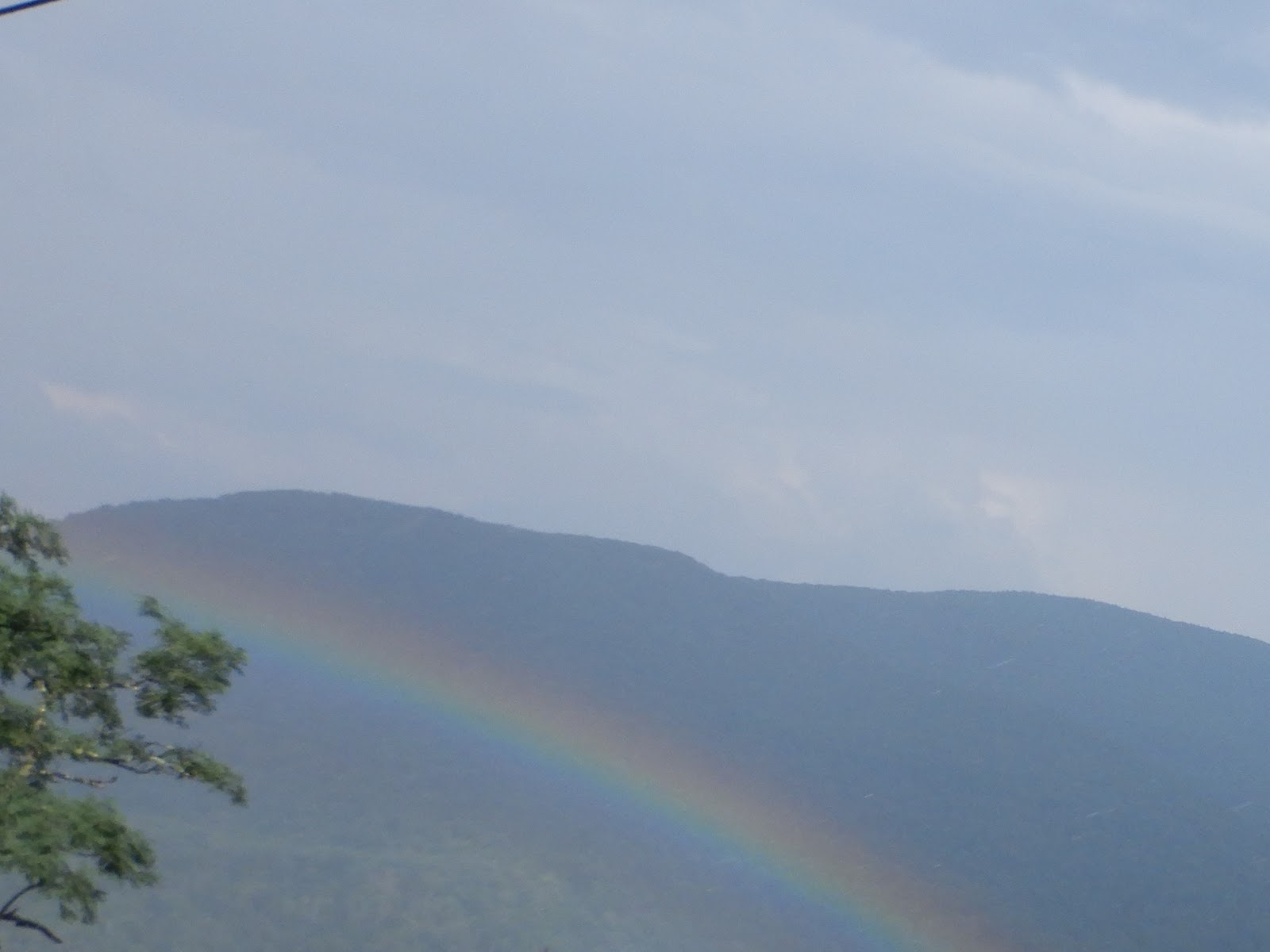
From there we meandered back to DC, taking little back roads, including more gravel, visited the smallest church in the lower 48 states (according to its sign), the Jenning-Randolph Lake Dam, and like many of our trips this summer, enjoyed a rainbow as we crossed the Shenandoah Valley on our way home.