6.26.18. Tuesday. St. John, New Brunswick to West Publico, Nova Scotia.
Breakfast at the hotel began at 6:30 a.m. I by-passed the yellow sponge “omelets” with the eerie orange filling (ubiquitous on “free breakfast included” buffets at many chains) and took just an English muffin. There were a number of other bikers and early risers, many headed for the ferry to Digby as we were.
Motorcycles boarded first, down on the deck with the 18 wheelers which is a part of a ferry I hadn’t seen before. It was much dirtier and more industrial than the car deck, one level up. Jeff used his new cuffs to help tie down the motorcycle, we locked our helmets, and then gathered up some stuff to take upstairs for the 2.5-hour ferry ride. Once we left the parking deck, the ferry was pretty plush. We settled into a comfy spot in the indoor lounge on the ferry and I got a breakfast of real eggs, that was pretty good, and Jeff got the bacon that came with my eggs. I bought a Christmas ornament in the gift shop. Capt’n Wilson roamed the ship a bit while I wrote notes and read. We both went out to an upper deck as we pulled close to shore before descending to ready the bike for departure.


Leaving the ferry, we stopped for a “Welcome to Nova Scotia” sign photo-op and geocache and also snapped pictures of the salmon-farm cages floating just off shore. Interesting to see how much fish farming there is!

The town of Digby is a bustling port. It’s a bit too industrial to qualify as charming, but seemed like a nice, friendly spot. We stopped at the old and very lovely Loyalist Cemetery for a geocache, winding through a neighborhood of shingled houses and shady trees.
Then, we headed east past Annapolis Royal and looped west to Port Royal, where the Degus party (new spelling!) settled after leaving St. Croix Island. This was apparently the settlement described in Wadsworth’s Evangeline. (Depending on the filters used, Spotwalla may not show our actual path. We crossed the causeway from Annapolis Royal to Granville Ferry twice; we did not leap from Digby to Port Royal across the water as Spotwalla may suggest.) We encountered here, and elsewhere, a substantial amount of road repair.


Paths that weave throughout Nova Scotia are helpfully identified by the tourist bureau as “trails.” Thus, we started our Nova Scotia trip with part of the Evangeline Trail but later would be on the Lighthouse Trail, Coastal Trail, etc.
Leaving Port Royal, we stopped at the Annapolis Tidal Generating Station! Yes! Most people would not be excited about this stop, but Jeff knows me, and put it on the route because he knew I’d like it. (I move in such energy-nerdy social circles that I recently spoke with another woman who also visited here and also love it!) The Bay of Fundy has the highest tides of anywhere in the world, peaking at around 50 feet (16 meters).The electric generator at the Annapolis station uses relatively conventional pumped-hydro technology, but it “pumps” water to the upper reservoir by capturing the incoming tide and then releases it when the outgoing tide is low enough to create a sufficient head to turn the turbine. Thus, it only operates twice a day. Unfortunately, photos of hydro projects are pretty boring, since all you usually see is the surface!
The display also explained, however, the more innovative tidal power project that is further up the bay, where the tides are stronger. There, a turbine placed in the bay turns with the tidal current using the tide’s kinetic energy. The first attempt to install this power project in 2009 failed because the turbine wasn’t strong enough to withstand the force of the tides and broke shortly after being installed. After all, no one had built a turbine for such a purpose previously. (Jeff was deeply disappointed in the engineers for not assessing the problem correctly.) The current turbine was out for repair at the time of our visit, but has otherwise been working since 2016. I heard recently, however, that the developer went bankrupt. Sigh. Innovation is difficult.
Back in Port Annapolis, next up was a shop called Catfish Moon for some crafts shopping (for me). Santa-on-a-Moose will join the other Santas on display in my home at Christmas. Jeff spent the time prowling the waterfront and learning about the town's history.


Fort Anne, consisting of a lovely white building, bunkers embedded in manicured hillsides, and lawns overlooking the water, made another lovely stop in Annapolis Royal, plus our first time sitting in the red chairs. These pairs of bright red (Maple Leaf red) Adirondack chairs have been placed by the tourist bureau at particularly scenic spots. This overlook of the water was very deserving! Also loved watching the Fort Anne maintenance crew mow the steep hills around the fort with a mower lowered down the slope on a tether and controlled remotely. The town was cute too, with lots of sculptures, interesting looking houses, many of a Victorian style, and lots of activity. Definitely a place that would nice to spend some time in.


Our next stop was supposed to be a lighthouse. As we approached the turnoff, our attention was seized by a wooden frame church, a quite large one, with four turrets surrounding its steeple, giving it a rather Disney-esque air. It was bordering a tidy little college campus with lots of solar panels, which we passed through after making our turn. Continuing down the road we came to our destination.

My attention first turned to the three wind turbines lazily spinning huge shadows across the ground. We then examined a small shrine set up on an embankment and then walked further down the road to what was supposed to have been a lighthouse. However, apparently the tower had blown down, leaving only a somewhat unattractive house, looking like a 1970’s beach house that had been abandon for lack of charm. We were looking for a geocache, so I ventured down a poorly mown track through a thicket of brush, grass and wildflowers, only to find myself emerging back onto the road near the shrine. A further check of the compass showed that the spot was actually on the far side of the shrine and easily accessible from the road without my brush rambling. C'est la vie! Jeff and I always find the hard way in and the easy way out when geocaching!
Going past the shrine led to the fourth feature on this little point of land – a fenced enclosure in which a “river” of brown water churned around a large oval track punctuated in two places by large brushy wheels that turned with the water flow. Jeff likened the flowing stream to a “lazy river” water park feature, which was probably the most charming compliment ever paid this sewage treatment facility.
After finding our geocache under the spreading branches of a large tree, we continued onward.
We worked our way along the western coast of Nova Scotia, with a lovely stop in Yarmouth. A memorial with a fountain splashing through a ship’s wheel stood in front of a vine covered memorial wall, with a colorful quilt mosaic around the corner. We watched musicians appearing to arrive almost by coincidence and carrying their instruments up a grand staircase to the park above. As the music started, a young woman was powerfully leaping up, and then down, the staircase from a squatting position. No need to pay gym fees when the local park has the perfect work-out equipment! What a great spot!


After Yarmouth, we continued down the coast, eventually reaching West Publico and our resting stop for the evening, the Red Coach Inn. Although we arrived too late for dinner, our hostess kindly sold us drinks to take back to the room. (We had purposefully stopped elsewhere since our preview of the menu suggested a vegetarian (me) and a non-fish eater (Jeff) would have very limited options in the Red Coach Inn dining room.) After an evening walk (plus some successful and unsuccessful geocaching and quite a few photos), we returned for a comfortable evening at the motel. It was nice to have the bike parked right outside. It was particularly handy the next morning when I found my hand washed items hadn’t dried completely. (Traveling with a tiny bag means you wear the same stuff over and over, and I prefer washing it out when I can.) I was able to drape the items over the bike in the morning while we breakfasted in the inn’s restaurant (nice breakfast!) and the bright morning sun made sure they were ready to go when we were.


Breakfast at the hotel began at 6:30 a.m. I by-passed the yellow sponge “omelets” with the eerie orange filling (ubiquitous on “free breakfast included” buffets at many chains) and took just an English muffin. There were a number of other bikers and early risers, many headed for the ferry to Digby as we were.
Motorcycles boarded first, down on the deck with the 18 wheelers which is a part of a ferry I hadn’t seen before. It was much dirtier and more industrial than the car deck, one level up. Jeff used his new cuffs to help tie down the motorcycle, we locked our helmets, and then gathered up some stuff to take upstairs for the 2.5-hour ferry ride. Once we left the parking deck, the ferry was pretty plush. We settled into a comfy spot in the indoor lounge on the ferry and I got a breakfast of real eggs, that was pretty good, and Jeff got the bacon that came with my eggs. I bought a Christmas ornament in the gift shop. Capt’n Wilson roamed the ship a bit while I wrote notes and read. We both went out to an upper deck as we pulled close to shore before descending to ready the bike for departure.


Leaving the ferry, we stopped for a “Welcome to Nova Scotia” sign photo-op and geocache and also snapped pictures of the salmon-farm cages floating just off shore. Interesting to see how much fish farming there is!

 |
| Fish farm |
 |
| Loyalist Cemetery, Digby |
 |
| Digby |


Paths that weave throughout Nova Scotia are helpfully identified by the tourist bureau as “trails.” Thus, we started our Nova Scotia trip with part of the Evangeline Trail but later would be on the Lighthouse Trail, Coastal Trail, etc.
Leaving Port Royal, we stopped at the Annapolis Tidal Generating Station! Yes! Most people would not be excited about this stop, but Jeff knows me, and put it on the route because he knew I’d like it. (I move in such energy-nerdy social circles that I recently spoke with another woman who also visited here and also love it!) The Bay of Fundy has the highest tides of anywhere in the world, peaking at around 50 feet (16 meters).The electric generator at the Annapolis station uses relatively conventional pumped-hydro technology, but it “pumps” water to the upper reservoir by capturing the incoming tide and then releases it when the outgoing tide is low enough to create a sufficient head to turn the turbine. Thus, it only operates twice a day. Unfortunately, photos of hydro projects are pretty boring, since all you usually see is the surface!
 |
| Tidal Generating Station |
Back in Port Annapolis, next up was a shop called Catfish Moon for some crafts shopping (for me). Santa-on-a-Moose will join the other Santas on display in my home at Christmas. Jeff spent the time prowling the waterfront and learning about the town's history.


Fort Anne, consisting of a lovely white building, bunkers embedded in manicured hillsides, and lawns overlooking the water, made another lovely stop in Annapolis Royal, plus our first time sitting in the red chairs. These pairs of bright red (Maple Leaf red) Adirondack chairs have been placed by the tourist bureau at particularly scenic spots. This overlook of the water was very deserving! Also loved watching the Fort Anne maintenance crew mow the steep hills around the fort with a mower lowered down the slope on a tether and controlled remotely. The town was cute too, with lots of sculptures, interesting looking houses, many of a Victorian style, and lots of activity. Definitely a place that would nice to spend some time in.
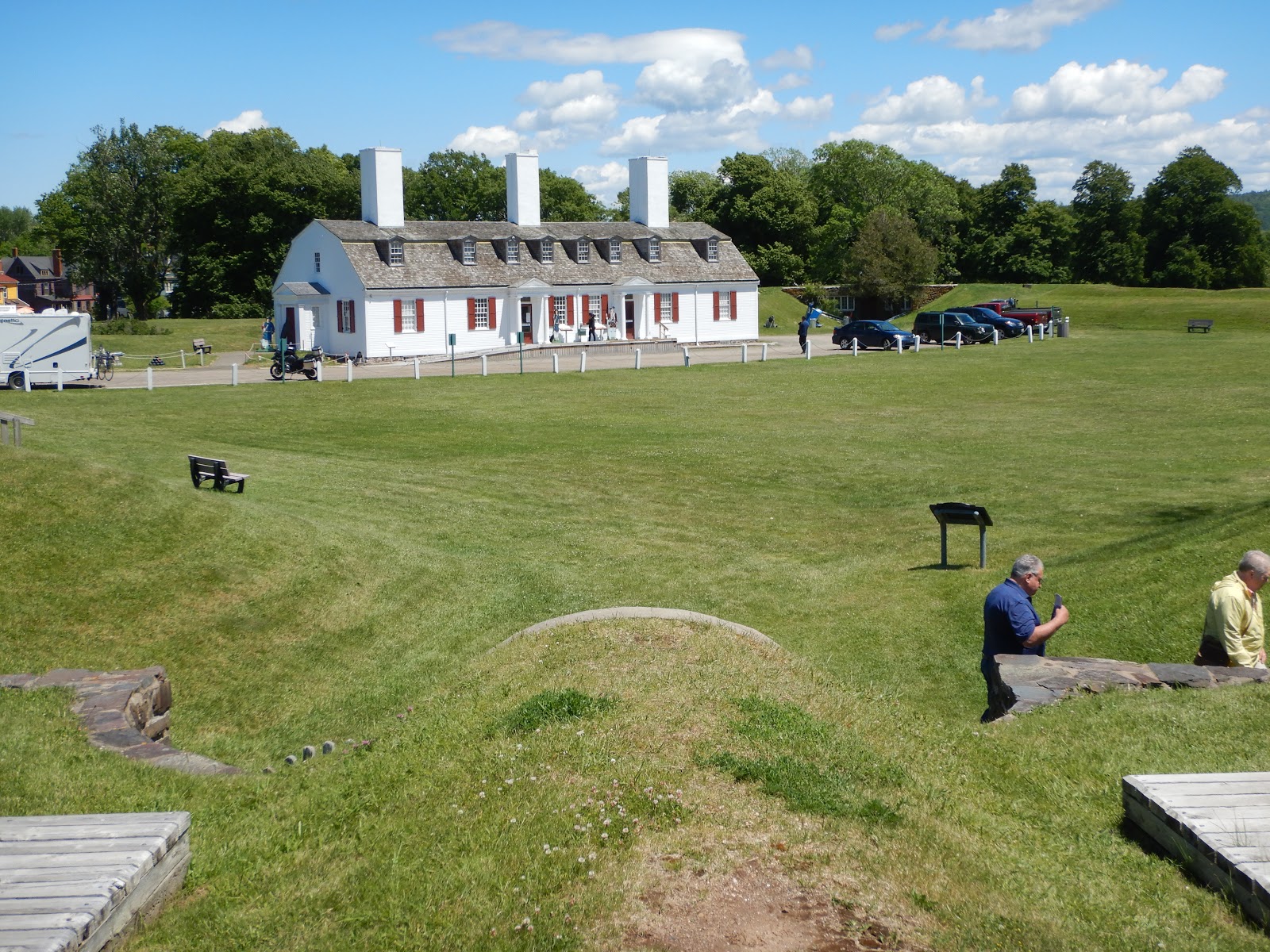 |
| Fort Anne |


Our next stop was supposed to be a lighthouse. As we approached the turnoff, our attention was seized by a wooden frame church, a quite large one, with four turrets surrounding its steeple, giving it a rather Disney-esque air. It was bordering a tidy little college campus with lots of solar panels, which we passed through after making our turn. Continuing down the road we came to our destination.

My attention first turned to the three wind turbines lazily spinning huge shadows across the ground. We then examined a small shrine set up on an embankment and then walked further down the road to what was supposed to have been a lighthouse. However, apparently the tower had blown down, leaving only a somewhat unattractive house, looking like a 1970’s beach house that had been abandon for lack of charm. We were looking for a geocache, so I ventured down a poorly mown track through a thicket of brush, grass and wildflowers, only to find myself emerging back onto the road near the shrine. A further check of the compass showed that the spot was actually on the far side of the shrine and easily accessible from the road without my brush rambling. C'est la vie! Jeff and I always find the hard way in and the easy way out when geocaching!
Going past the shrine led to the fourth feature on this little point of land – a fenced enclosure in which a “river” of brown water churned around a large oval track punctuated in two places by large brushy wheels that turned with the water flow. Jeff likened the flowing stream to a “lazy river” water park feature, which was probably the most charming compliment ever paid this sewage treatment facility.
After finding our geocache under the spreading branches of a large tree, we continued onward.
We worked our way along the western coast of Nova Scotia, with a lovely stop in Yarmouth. A memorial with a fountain splashing through a ship’s wheel stood in front of a vine covered memorial wall, with a colorful quilt mosaic around the corner. We watched musicians appearing to arrive almost by coincidence and carrying their instruments up a grand staircase to the park above. As the music started, a young woman was powerfully leaping up, and then down, the staircase from a squatting position. No need to pay gym fees when the local park has the perfect work-out equipment! What a great spot!


After Yarmouth, we continued down the coast, eventually reaching West Publico and our resting stop for the evening, the Red Coach Inn. Although we arrived too late for dinner, our hostess kindly sold us drinks to take back to the room. (We had purposefully stopped elsewhere since our preview of the menu suggested a vegetarian (me) and a non-fish eater (Jeff) would have very limited options in the Red Coach Inn dining room.) After an evening walk (plus some successful and unsuccessful geocaching and quite a few photos), we returned for a comfortable evening at the motel. It was nice to have the bike parked right outside. It was particularly handy the next morning when I found my hand washed items hadn’t dried completely. (Traveling with a tiny bag means you wear the same stuff over and over, and I prefer washing it out when I can.) I was able to drape the items over the bike in the morning while we breakfasted in the inn’s restaurant (nice breakfast!) and the bright morning sun made sure they were ready to go when we were.